Ready for your end of year getaway? Read this first!

With the holiday season fast approaching, many divers are likely to have plans for a diving trip away, so we’ve put together a collection of Travel Tips that will help ensure your gear is ready and your stomach remains healthy.

Getting ready for your end of year getaway? Read this first!

With the holiday season fast approaching, many divers are likely to have plans for a diving trip away, so we’ve put together a collection of Travel Tips that will help ensure your gear is ready and your stomach remains healthy. After all, no one wants a stomach bug or gear issue ruining the precious time they have on a much looked forward to break! Continue reading “Ready for your end of year getaway? Read this first!”
Calls to DAN Asia-Pacific for Help : Q4 2017

Every week DAN Asia-Pacific receives calls for help from Members, and non-Members, from destinations all over the world and for a whole plethora of reasons, not all of which are diving-related. Going forward, we’ll be sharing insights from these calls.

Every week DAN Asia-Pacific receives calls for help from Members, and non-Members, from destinations all over the world and for a whole plethora of reasons, not all of which are diving-related. So commencing in January 2018, we will start sharing very brief details of calls received on a regular basis. Continue reading “Calls to DAN Asia-Pacific for Help : Q4 2017”

The Denial that Damaged my Brain

DCS can be a very subtle sickness, something we can easily deny and put down to the tiredness of a busy dive schedule, or change of routine. But the effects, even after treatment, can be lasting.

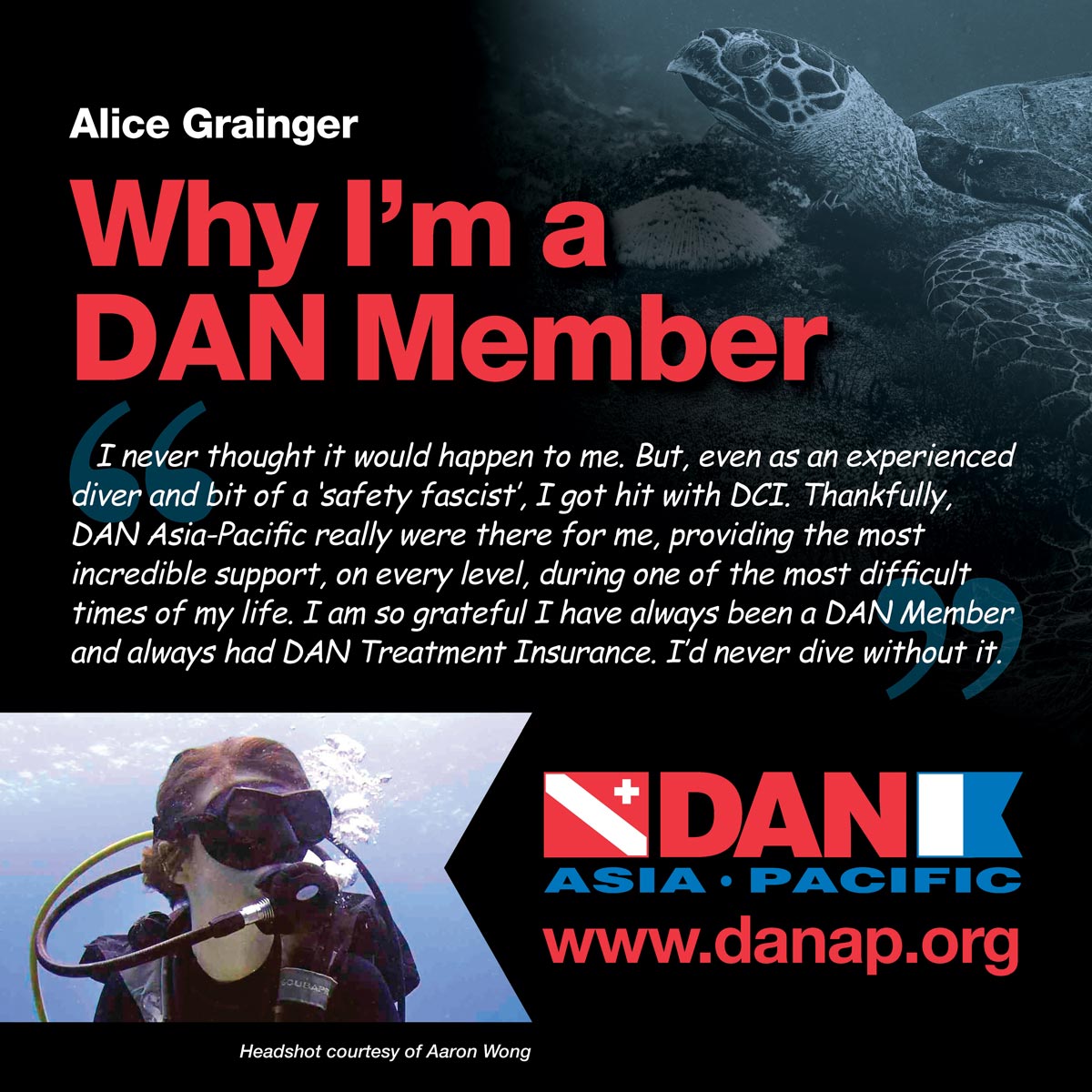
Even though DCS might seem subtle, it could be serious. DAN AP Member Alice Grainger shares her experience of denying her decompression sickness due to the lack of the usual physical symptoms, until she decided her brain clearly wasn’t working, and went to seek medical help. With comments by DAN AP Founder, John Lippmann. Continue reading “The Denial that Damaged my Brain”

Flying After Diving – what are the risks?

You may have heard of divers who fly less than 12-hours after diving with no negative impact and others that wait a longer period who end up with symptoms of DCI and wondered why this happens. Dr John Parker, a Diving physician and Senior Dive Medical Consultant for DAN, discusses this issue.

Flying After Diving

You may have heard of divers who fly less than 12-hours after diving with no negative impact and others that wait a longer period who end up with symptoms of DCI and wondered why this happens. Dr John Parker, a Diving physician and Senior Dive Medical Consultant for DAN, discusses this issue. Continue reading “Flying After Diving – what are the risks?”

When to Call a Dive

In this article, DAN Asia-Pacific’s General Manager, Scott Jamieson, discusses the importance of knowing your personal limits and when to call (or abort) a dive

In this article, DAN Asia-Pacific’s General Manager, Scott Jamieson, discusses the importance of knowing your personal limits and when to call (or abort) a dive.

During our basic dive training we are taught that if a dive doesn’t feel right we should abort it. The reality is, despite these lessons, many people find themselves on dives for which they lack the confidence or experience to be undertaking. This places unnecessary stress on the diver, both physically and mentally, and this can lead to unnecessary incidents involving injury or even death. Continue reading “When to Call a Dive”

But I Was Within The Limits of My Diving Computer!

Most divers these days use dive computers and appear to be reasonably confident that by doing so they will avoid decompression illness (DCI) as long as they dive within its limits. Dive computer algorithms are based on decompression models, which are only generalisations and deeper dives, longer dives, with shorter surface intervals produce less accurate decompression calculations.

Most divers these days use dive computers and appear to be reasonably confident that by doing so they will avoid decompression illness (DCI) as long as they dive within its limits.

One DAN Member, who called for help, commented: “But I didn’t believe it could be DCI as there were no violations according to my computer”, a relatively common reaction.

John Lippmann DAN Asia-Pacific’s Founder, Chairman & Director of Research explains why deeper dives, longer dives, with shorter surface intervals and repetitive diving, can often be inviting problems. Continue reading “But I Was Within The Limits of My Diving Computer!”

In the Event of a Diving Emergency, Be Prepared Before Calling a DAN Hotline

SAFETY TIP: In the Event of a Diving Emergency, Be Prepared Before Calling a DAN Hotline: make sure you have a call-back number available. NOTE: All divers can call a DAN Hotline for advice, but DAN can only manage the evacuation & treatment of members. You can sign up here: http://www.danap.org.

SAFETY TIP: In the Event of a Diving Emergency, Be Prepared Before Calling a DAN Hotline

  • Firstly, have a call-back number available
  • Call the hotline: +61 8 8212 9242 or 1800 088 200
  • These hotlines will put you in contact with a diving doctor
  • NOTE: All divers can call a DAN Hotline for advice
  • But DAN can only manage the evacuation & treatment of members
  • Not a member yet? You can sign up here.

Continue reading “In the Event of a Diving Emergency, Be Prepared Before Calling a DAN Hotline”

Beach Oxygen in Bali

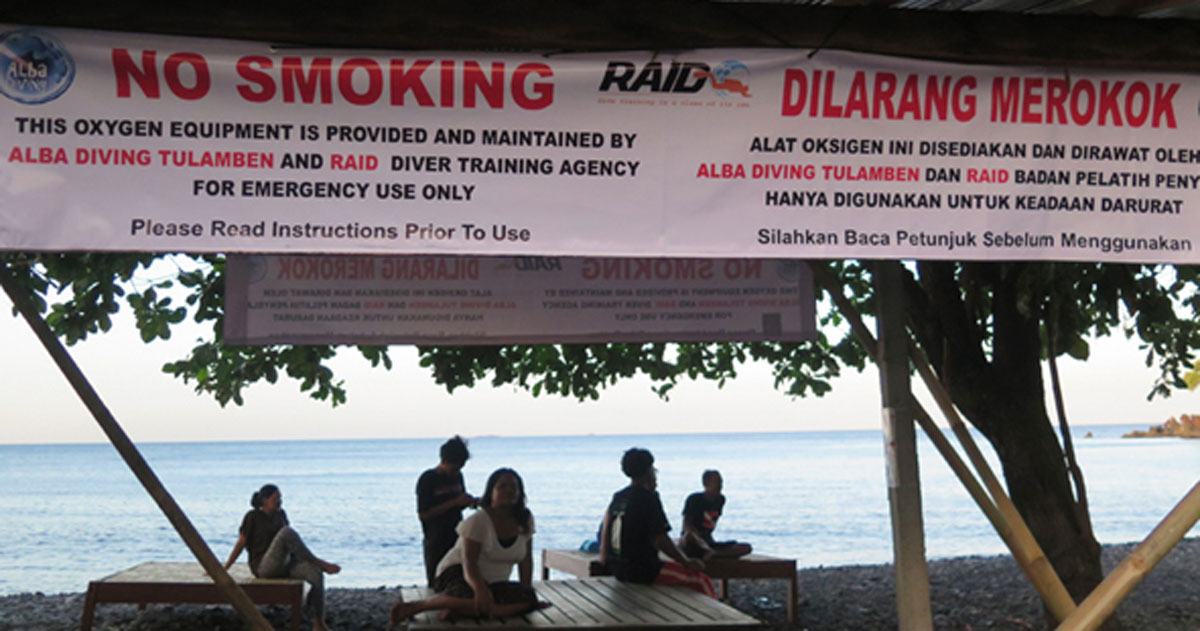
There’s a new installation near Tulamben beach: roofed plinth with a 50-litre bottle of oxygen and an oxygen delivery kit. A banner declares that the facility has been provided by Alba Diving.

By Simon Pridmore

The other day, I drove down to the parking lot near the drop off at the eastern end of Bali’s Tulamben Bay. I hadn’t been there for a while. As I set my gear up I noticed a new installation at the edge of the car park, near the beach. There was a new roofed plinth that housed, to my surprise, a 50-litre bottle of oxygen and an oxygen delivery kit. A banner attached to the roof declared that the facility had been provided by Alba Diving.

“Extremely impressed, after the dive I headed to Villa Alba, Alba Diving’s beachside resort, and asked the owner, Alex Ford, what the story was.Continue reading “Beach Oxygen in Bali”

Party on… not! The dangers of partying too hard the night before

Excerpt: Divers often gather for a beer or two after a long day of diving, and some drink more than just one or two! What are the risks – especially when we are likely to get back in the water early the next morning?

Divers often gather for a beer or two after a long day of diving, and some, let’s face it, drink more than just one or two! But what are the risks involved in doing this, especially when we are likely to get back in the water early the next morning? Continue reading “Party on… not! The dangers of partying too hard the night before”

Human Factors Skills in Diving Course, hosted by DAN AP, 29-30 November

An intensive 2-day course for instructors, instructor trainers and those who are exposed to higher levels of risk, for example in cave and technical diving, to improve their personal and team performance. Hosted by DAN AP and held at DAN AP HQ, 29-30 November, led by Gareth Lock – GUE’s Director for Risk Management.

Human Factors Skills in Diving Course hosted by DAN AP

This unique training course is led by Gareth Lock, an Open Circuit advanced trimix diver, recently appointed GUE’s Director for Risk Management. (Bio below).

The intensive 2-day course is for instructors, instructor trainers and those who are exposed to higher levels of risk, for example in cave and technical diving, to improve their personal and team performance, and improve their safety as a by-product. Continue reading “Human Factors Skills in Diving Course, hosted by DAN AP, 29-30 November”